

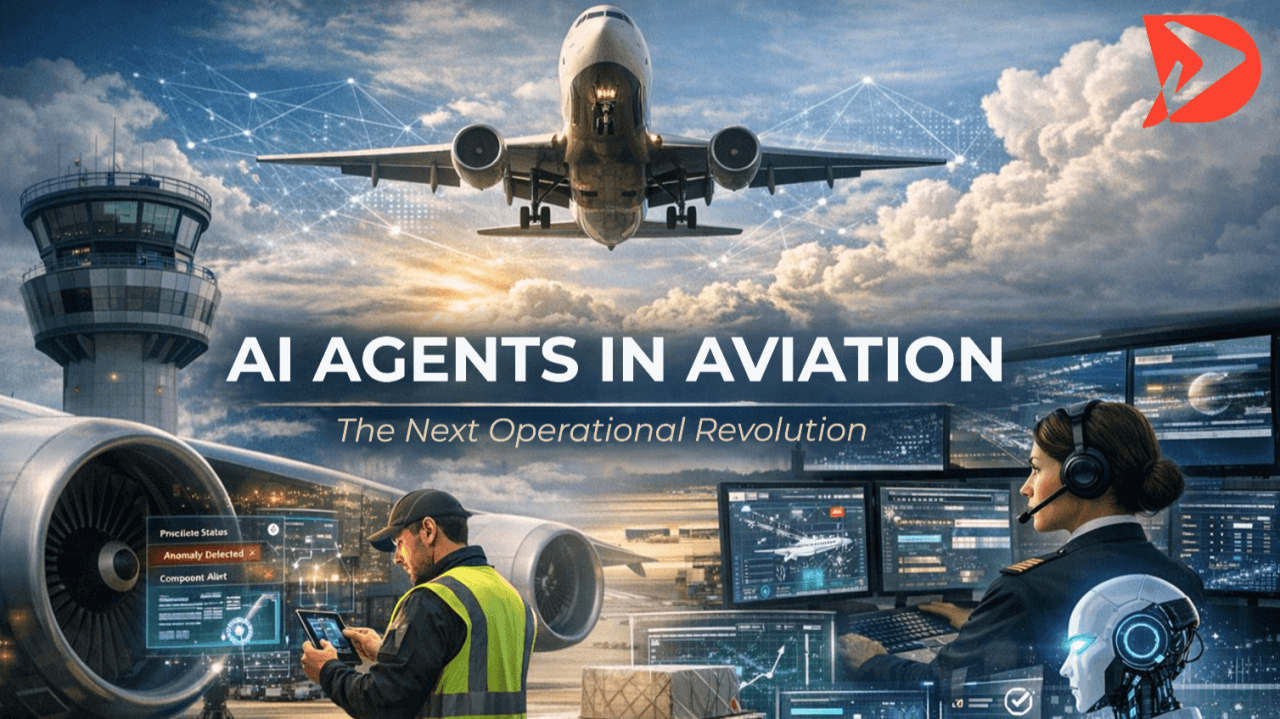
Aviation does not have the luxury of experimenting with technology in the abstract. It operates in an environment defined by safety, compliance, asset intensity, fragmented data, and constant operational pressure. That is exactly why AI agents matter now. They are not interesting because they are new. They are important because aviation is reaching a scale and complexity point where traditional human-led workflows will struggle to keep up. IATA’s latest long-term demand projection expects global air passenger demand to more than double by 2050, reaching 20.8 trillion revenue passenger kilometer RPKs under mid range scenario, up from 9 trillion in 2024.
What an AI agent means in Aviation
In practical terms, an AI agent is not just a chatbot or a reporting tool. It is a software system that can interpret inputs, reason across multiple datasets or rules, recommend or execute bounded actions, and adapt workflow to achieve an operational goal. In aviation, that goal might be identifying an impending maintenance event, surfacing missing lease return records, reprioritizing a disruption workflow, or answering an operational compliance question in real time. That framing is consistent with how EASA defines AI-based systems more broadly: systems that infer from inputs to generate predictions, recommendations, content, or decisions that influence real or virtual environments.
Why the timing is different now
Three forces are converging.
First, demand is growing sharply. IATA’s 2026 long-term outlook shows that aviation must absorb a much larger absolute volume of traffic over time, even as long-run growth rates moderate relative to earlier decades. That means more aircraft, more cycles, more disruptions, more records, and more transitions moving through the system.
Second, the industry’s labor and skills burden is rising. Boeing’s 2025 Pilot and Technician Outlook projects that the global commercial aviation sector will require nearly 2.4 million new personnel through 2044, including 710,000 maintenance technicians. Airbus’s 2025 Global Services Forecast similarly projects demand for 705,000 new technicians by 2044 and estimates that maintenance operations support alone will represent a US$100 billion market by 2044.
Third, the regulatory environment is no longer waiting on the sidelines. The FAA’s Roadmap for AI Safety Assurance lays out principles for introducing AI inside the existing aviation safety ecosystem, while EASA has moved from roadmap into proposed regulatory guidance tied to the EU AI Act. The implication is clear: aviation is moving from curiosity about AI to structured adoption under safety assurance and governance disciplines.
Where AI agents can create the most value
The strongest near-term use cases are not glamorous. They sit in the operating core of aviation.
Maintenance is one of the clearest domains for agentic AI because the workflow is already data-rich, repetitive, time-critical, and expensive when delayed. Boeing describes predictive maintenance as a way to detect potential issues earlier and reduce downtime. Airbus points to expanding predictive maintenance across more aircraft families and, from 2026, extending those capabilities beyond Airbus aircraft, with ambitions to move toward a more unified offering that reaches into asset management and eOperations.
This is where AI agents can move beyond analytics dashboards. Instead of merely flagging anomalies, an agent can assemble the relevant fault history, check technical records, compare recurring events, suggest troubleshooting paths, recommend material provisioning, and escalate only when thresholds are breached. In other words, the value is not only better prediction. It is workflow compression.
This is the most under-discussed but potentially most valuable application for the aviation finance and technical services ecosystem. While regulators understandably focus on safety-critical AI, the lessor-airline-MRO interface is full of high-friction, document-heavy, deadline-sensitive work. Technical records reviews, AD/SB status checks, LLP traceability, work scope sequencing, damage assessment histories, and contractual condition reconciliation are all areas where AI agents could reduce cycle time and value leakage. This is an industry inference rather than a formal regulator claim, but it follows directly from the pattern regulators and OEMs are encouraging: AI first as decision support, bounded assistance, and human-supervised collaboration.
For lessors and asset managers, the commercial logic is straightforward. A delayed or poorly managed transition does not just create operational noise; it can affect lease revenue continuity, maintenance reserves, marketability, and redelivery cost recovery. AI agents are well-suited to these environments because the bottleneck is often not the absence of data, but the slow conversion of data into action.
The FAA has been explicit that AI should not be viewed only as something needing oversight, but also as a tool to enhance safety. Its roadmap includes both assurance of AI systems and the use of AI for safety improvements. A later FAA presentation through ICAO describes AI as enabling a shift from reactive accident investigation toward proactive incident prevention, including through modernization of ASIAS, the U.S. Aviation Safety Information Analysis and Sharing system.
That is a significant strategic signal. The next wave of AI in aviation may not be “autonomous flight.” It may be intelligent agents embedded into safety management systems, quality systems, and operational control functions that detect weak signals earlier than manual reviews can.
IATA’s March 2026 cargo announcement is notable because it shows AI moving from theory into operational tooling and industry coordination. IATA launched an AI Subject Matter Expert tool to help cargo operational teams query standards and publications in plain language, and it also launched an Air Cargo AI Excellence Hub focused on best practices, governance, compliance, and standards development.
Across airports and airlines, SITA reports continued expansion of biometrics and digital passenger processing. In early 2025, it said more than half of airports planned biometric rollout for check-in and bag drop by 2026, while 70% of airlines expected to adopt biometric ID management systems in the same timeframe.
These are not all “agents” in the strict sense, but they show the direction of travel: aviation is building the digital infrastructure that agentic systems need. Once data, identity, and workflow layers mature, the next logical step is intelligent orchestration.
The real constraint: trust, not capability
The bottleneck for AI agents in aviation will not be model capability alone. It will be trustworthiness.
FAA guidance emphasizes that AI must be introduced within the disciplined aviation safety ecosystem, not outside it. It also stresses the need to distinguish between systems that are “learned” before deployment and systems that continue “learning” online, with the latter presenting a harder assurance challenge.
EASA’s current proposal makes the same point from another direction. It states that traditional development assurance methods do not fully address the stochastic nature of machine-learning models, and that human-factors methods must evolve to handle new forms of human-AI teaming. Draft framework covers trustworthiness, high-risk classification, human-centered design, and assurance expectations.
What this means for aviation leaders now
For airlines, AI agents should be prioritized in operations control, disruption management, maintenance planning, and technical records workflows. For MROs, the biggest gains are likely in workscoping, material readiness, inspection support, and document-heavy turnaround coordination. For lessors and asset managers, the opportunity sits in transition execution, records intelligence, maintenance exposure forecasting, and portfolio-level decision support.
The strategic mistake would be to treat AI agents as a side experiment owned only by innovation teams. Aviation’s next phase of value creation is likely to come from embedding agentic intelligence into existing operational bottlenecks, not from launching isolated demos. That matters even more in an industry facing long-run traffic growth, technician shortages, rising services demand, and tighter scrutiny on safety and compliance.
AI agents will not replace aviation expertise. They will expose where expertise is currently trapped inside slow, manual, fragmented processes.